

Recent Doctoral Graduates from the Kavli Institute for Nanoscience Discovery: Dr Navoneel Sen, Dr Kishwar Iqbal and Dr James Eaton
Kavli Oxford's Recent Doctoral Graduates
We asked our recent doctoral graduates, Navoneel Sen, Kishwar Iqbal and James Eaton, to tell us about their research, what they are doing next, and their thoughts on interdisciplinarity.
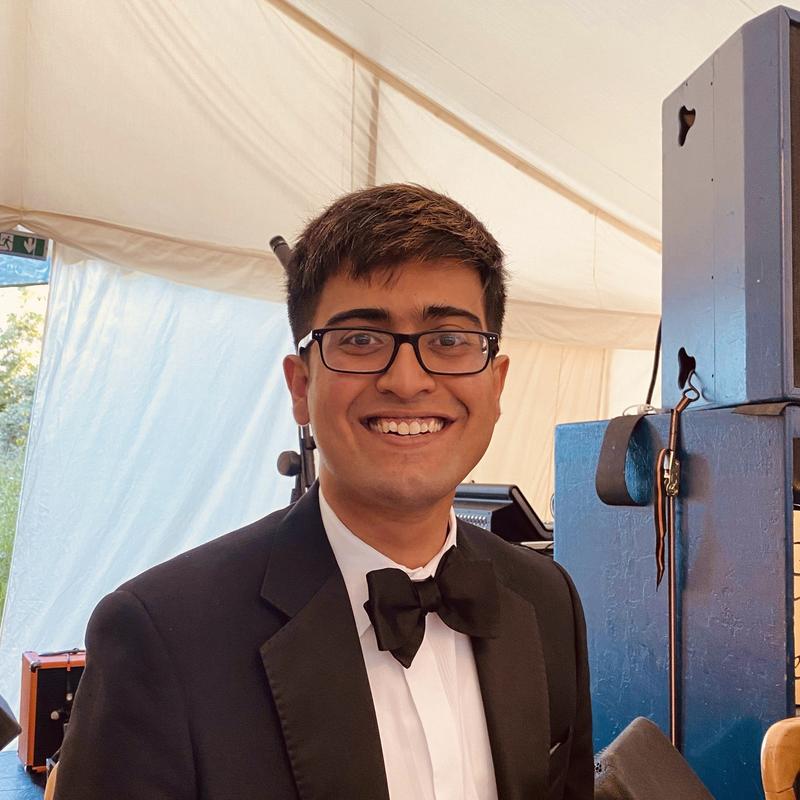
Dr Navoneel Sen
Thesis Title: Biophysical approaches to unravel complex protein interactions
Supervisors: Professor Justin Benesch and Professor Syma Khalid
Thesis summary:
Proteins are the molecular machines that keep our cells and tissues functioning. Rather than working alone, they form networks of interactions with other proteins. These interactions determine how proteins behave and are essential for maintaining healthy cells, particularly in mechanically active tissues such as the heart. During my DPhil, I investigated how proteins assemble, interact, and respond to their environment by combining computational modelling with laboratory experiments.
Research summary: The first part of my DPhil was focused on understanding how proteins interact under biomechanical stress. We first investigated how the small heat shock protein HSPB5 interacts with the cardiac protein titin, combining artificial intelligence-based structure prediction with mass spectrometry to better understand heart muscle elasticity. We then explored how the related protein HSPB7 forms dimers, using evolutionary analysis, ancestral sequence reconstruction, molecular simulations, and experimental measurements to uncover its structural basis. Building on this, we characterised a unique interaction between HSPB7 and filamin C, integrating computational modelling with evolutionary and mass spectrometry data to define their heterodimerisation. Finally, we examined protein-lipid interactions through coarse-grained molecular dynamics simulations, showing how membrane composition influences nanopore diffusion. These studies demonstrate how integrating computational and experimental approaches can reveal new insights into protein structure, dynamics, and interactions in complex biological systems.
Next steps:
Following my DPhil, I will continue in the Benesch group as a postdoctoral researcher, where I aim to explore the feasibility of modulating these cardiac protein-protein interactions to assess their potential as therapeutic targets.
Insights on interdisciplinarity:
My experience at the intersection of computation and experiment has highlighted the transformative potential of interdisciplinary science. The ability to move fluidly between in silico prediction and experimental validation allowed me to interrogate protein interactions from multiple scales. As biological questions become increasingly complex, I believe that future breakthroughs will depend on researchers who are comfortable integrating diverse technical approaches. My DPhil has instilled in me a deep appreciation for collaboration across traditional disciplinary boundaries.
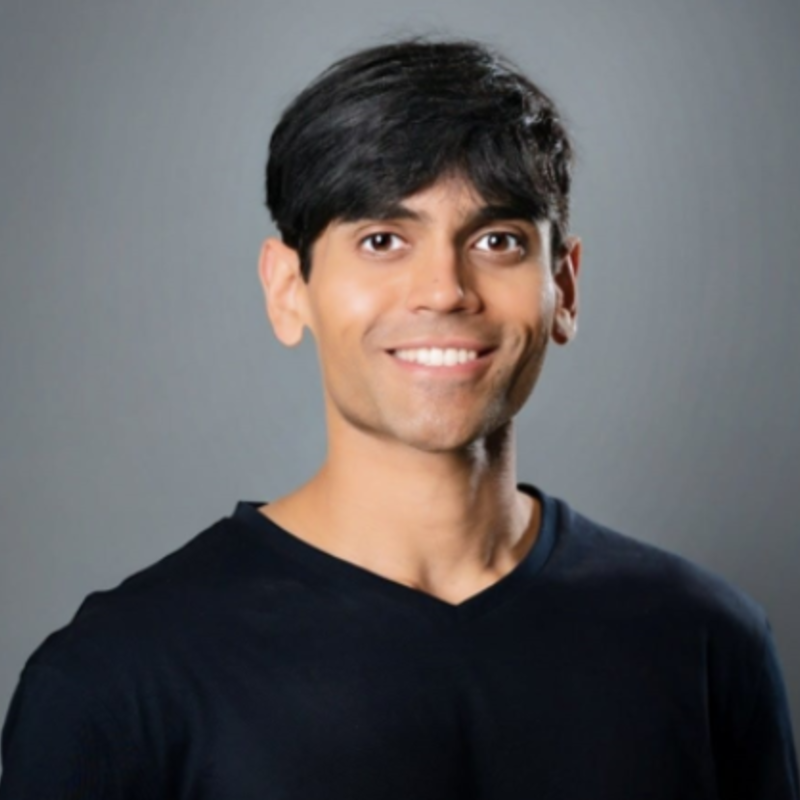
Dr Kishwar Iqbal
Thesis Title: Transforming scattering-based single particle detection by deep learning and novel optical designs
Supervisor: Professor Philipp Kukura
Thesis summary:
A fundamental piece of the puzzle in understanding biomolecular systems is the ability to measure mass. This capability allows us to answer some of the most basic yet essential scientific questions: What exactly is in my sample? How much of it is present? How does it change under different conditions? And which components interact with one another?
Mass photometry, a label-free, solution-based technique for precisely measuring the mass of individual biomolecules, provides answers to these fundamental questions. The technique uses an interferometric light-scattering microscope to detect tiny changes in reflectivity as single molecules land on a glass surface. By analysing these subtle optical signals, the molecular mass can be determined. Having already seen rapid adoption across academia and industry, the impact of mass photometry for biomolecular quantification ultimately depends on its measurement performance.
My work explores how advances in optical design and machine learning–based analysis can further enhance the performance of mass photometry. Inspired by the evanescent field illumination used in total internal reflection fluorescence microscopy, I developed a next-generation microscope featuring azimuthally rotating illumination, delivering excitation from all directions. This approach significantly improves signal-to-noise ratios and suppresses background when imaging nanoscale samples. Complementing these hardware innovations, I designed a deep learning framework to enhance mass accuracy by classifying single-molecule landing events, enabling the detection of even the most subtle signal fluctuations that can otherwise limit precision. Through this co-evolution of hardware and software, my work aims to broaden the impact of mass photometry across the life sciences.
Next steps: Life Sciences Consulting in London!
Insights on Interdisciplinary research:
Coming from a natural sciences background, the interdisciplinary spirit of the Kavli Institute felt like a perfect fit. As a student here, you can really try everything, from designing experiments at the bench to building and tuning cutting-edge microscopes, all while having world-leading experts just a few desks away. It is a fantastic place to grow and develop as a young scientist.
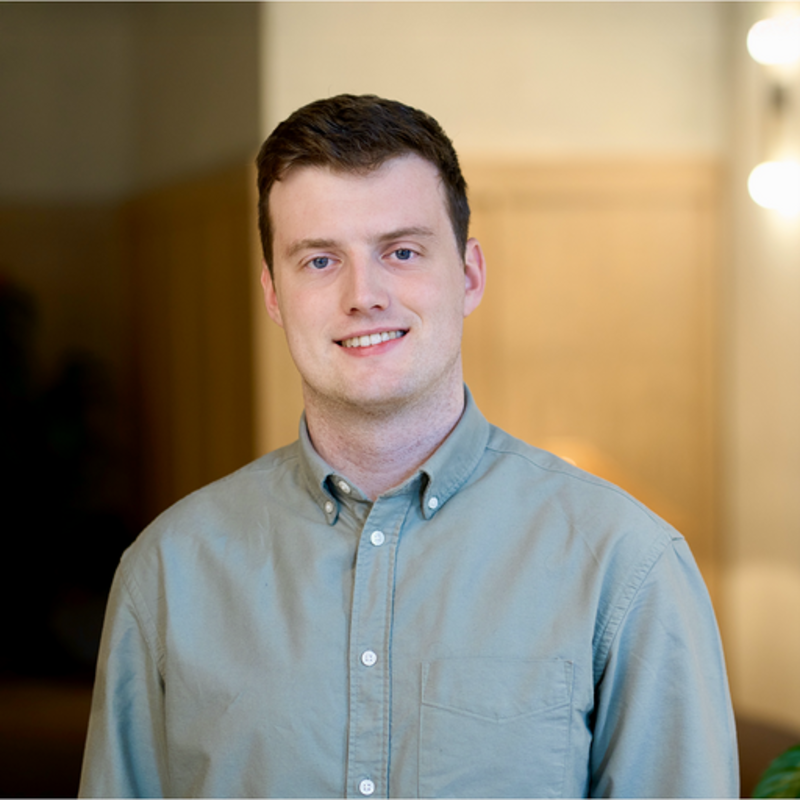
Dr James Eaton
Thesis title: Biological NMR: Probing Biomolecular Condensates, Exploration of a Disordered Virus Capsid Protein and Reducing Molecular Size Limitations
Supervisor: Professor Andrew Baldwin
Thesis summary:
Solution-state nuclear magnetic resonance (NMR) spectroscopy can characterise atom-specific structural and dynamical information of biomolecules. NMR excels in studying dynamical and liquid-state systems; however, its use in slowly tumbling biomolecules is restricted, due to signal intensity and resolution limitations. In my thesis, NMR was used to characterise biomolecular condensates and a disordered virus capsid protein. This was followed by an exploration of methods to enhance NMR spectral quality for slowly tumbling biomolecules. Biomolecular condensates are formed through liquid-liquid phase separation and provide cellular compartmentalisation without a phospholipid membrane. The ability of condensates to partition metabolites was determined using an NMR-based method, which showed trends similar to “like-dissolves-like”, used extensively to predict partitioning into organic solvents. Additionally, NMR revealed a significant change in the dynamical and chemical properties of water inside condensates. These measurements support the growing evidence that biomolecular condensates act as distinct solvents.
Secondly, the properties of an adenovirus capsid protein, N-terminal truncated protein VI (∆54-pVI), were explored using NMR. Adenoviruses can cause common respiratory illnesses and are exploited as viral vectors for vaccination. Protein VI is essential for membrane disruption and endosomal escape into a host cell, crucial for adenoviral infectivity. Diffusion NMR showed the highly disordered nature of ∆54-pVI; however, the assignment of chemical shifts revealed regions with amphipathic α-helical propensity, which is thought to enhance interactions with membranes.
Finally, the benefits of 13CF3 labelling on slowly tumbling biomolecules were also assessed. Experimental measurements on a 395 kilodalton protein showed the 13CF3 spin-label had favourable relaxation properties. Simulations predicted that the relaxation rate of the slowest relaxing coherence would be largely independent of molecular tumbling. Therefore, 13CF3 labelling schemes could extend the applications of NMR in slower-tumbling biomolecules.
Next steps:
I have started an exciting position as a scientist in magnetic resonance at Bind Research, a new not-for-profit focussed research organisation aiming to understand how small molecules interact with intrinsically disordered proteins. By better understanding these interactions, more effective and cheaper medications to treat diseases linked to disordered proteins could be developed.
Insights on interdisciplinary research:
Throughout my DPhil at the Kavli, I had the fantastic opportunity to work with scientists from a wide range of scientific backgrounds. The interdisciplinary skills I developed at the Kavli put me in a great position to thrive in my new role at Bind Research.

